Hull Services

Controlled preparation and coating systems below the waterline

Hull Treatments

Advanced surface preparation and protective hull coatings

Comprehensive hull preparation and coating systems designed to protect underwater surfaces, improve efficiency and ensure long-term performance in marine environments.
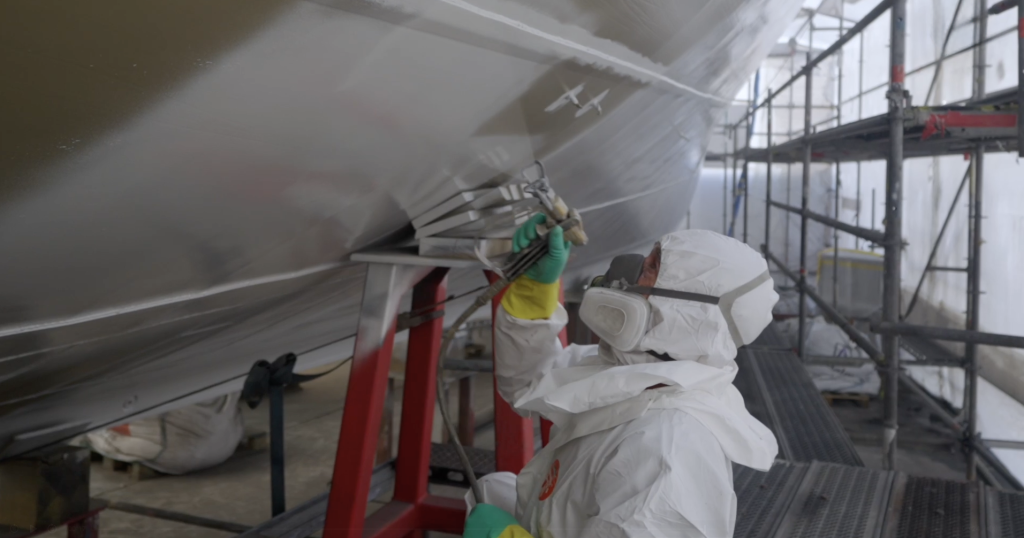
Technician applying antifouling paint to the hull of a superyacht in a shipyard using a spray gun with scaffolding in the background

Antifouling

Protective coatings to prevent marine growth and optimise performance
key advantages
  • Reduced drag and improved hydrodynamic efficiency.
  • Lower fuel consumption and emissions.
  • Protection of the hull surface against marine growth.
  • Extended coating lifespan under controlled application.
  • Suitable for full hull coatings and partial underwater areas.
  • Application under controlled environmental parameters (humidity, temperature and surface condition).
  • Compatible with all major antifouling systems and paint manufacturers.
  • Integrated quality control throughout preparation and application phases.
  • Simultaneous project capacity by Nautiunderwater: up to 10 antifouling projects across different locations.
  •  
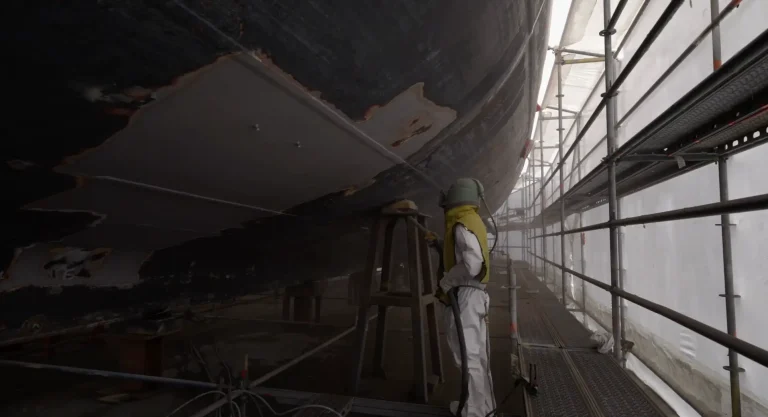
Technician performing sandblasting on a superyacht hull inside a covered shipyard with scaffolding and protective equipment

Sandblasting

Abrasive surface preparation for heavy-duty coating systems
key advantages
  • Effective removal of heavy coatings and corrosion.
  • Creation of an optimal surface profile for coating adhesion.
  • Suitable for localised repairs or full surface preparation.
  • Industry-standard method for steel substrate preparation.
  • Nautiunderwater sandblasting to bare metal capacity: up to 400 m² per day.
  • Suitable for localised areas or complete hull sections.
    Adjustable blasting grades according to project requirements and coating specifications.
  • Compatible with steel hulls and structural components.
  • Execution following defined safety and containment procedures.
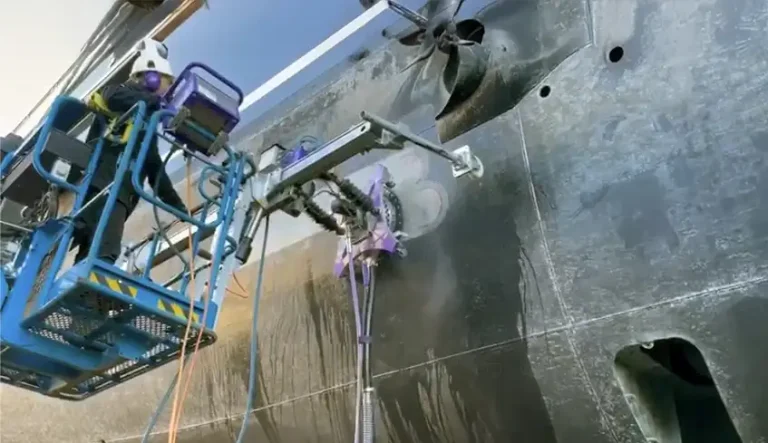
Technician using high-pressure water jetting equipment to clean a superyacht hull in a shipyard

Water Jetting

High-pressure water cleaning using automated robotic systems
key advantages
  • No need for protective coverings – Saves time and costs.
  • Zero solid waste generation – Unlike abrasive blasting, it eliminates aluminium silicate and copper slag residues.
  • Eco-friendly and safer process through water recycling.
  • Surface preparation rates from 18 m²/hr (140 m²/day) with one team and one shift.
  • Maximum capacity of up to 72 m²/hr (570 m²/day) using automated robotic systems.
  • Controlled pressure range (1,000–1,500 bar) suitable for antifouling removal down to primers or substrate.
  • Precise and uniform cleaning across large hull areas with reduced operator exposure.
  • Water recovery options and recycling for improved sustainability and safer working conditions.

QUALITY

Precision sets the standard

Quality beyond words. Measured, verified and proven

Nauti standard

Unwavering commitment to underwater performance and protection.

What sets us apart is the application of measurable and verifiable Quality Standards through our own management model, the NautiStandard — specifically adapted for underwater and corrosion-critical operations.

The NautiStandard is built on a comprehensive system of controls, inspections and performance tests carried out throughout every phase of underwater works, from surface preparation to final coating application.

These procedures ensure that each stage meets strict technical criteria, guaranteeing long-term protection, structural integrity and reliable performance below the waterline.

This model is based on the principles of ISO 9001 and aligned with the technical guidelines of ICOMIA.
Our standards go further, incorporating stricter internal protocols specifically developed for corrosion control, surface preparation and underwater coating systems.

Key quality inspection points

01
NS/AF2: IT1

Visual inspection of cleanliness.

02
NS/AF2: IT2
Visual inspection of the cleanliness grade and surface profile.
03
NS/AF2: IT3
Soluble salts assessment.
04
NS/AF2: IT4
Surface dust assessment.
05
NS/AF2: IT5
Assessment and control of ambient conditions.nt.
06
NS/AF2: IT6
Assessment of dry film thickness.
07
NS/AF2: IT7
Visual inspection of the Paint finish.
Below the waterline, performance is the foundation.
Juan Liebana
Quatity control director
Quality control at every underwater stage

Our Quality Department works closely with the client and the Paint Inspector to ensure compliance with the highest standards and the requirements of the Inspection and Test Plan (ITP).

The Quality Management inspectors from our independent division continuously collect data to maintain optimal conditions and achieve flawless results in every project phase.

To meet the specific needs of our clients, we also collaborate with renowned external and independent inspectors, such as WREDE, CCS, ATLAS, MYPAI, and OPTIMIZA.

As part of this process, every layer of the coating system — from substrate preparation to the final top coat — is applied and verified under strict quality protocols.

Superyacht hull substrate preparation below the waterline
substrate
Initial assessment of the hull base material, verifying its condition before any surface preparation begins. This step ensures that the substrate is free from defects that could compromise adhesion or long-term coating performance.
Sandblasting process on a superyacht hull below the waterline
Sandblasting
Controlled abrasive surface preparation to remove existing coatings, corrosion and contaminants. The process is verified to achieve the specified cleanliness grade and surface profile required for optimal coating adhesion.
Anticorrosive primer applied to a superyacht hull below the waterline
Anticorrosive Primer
Application under strictly controlled environmental conditions to protect the exposed substrate against corrosion. This layer forms the primary protective barrier and provides a stable, compatible base for subsequent coating layers.
High solid primer application on a superyacht hull below the waterline
High Solid Primer
High-build primer applied with controlled thickness to level the surface and build the coating system. Thickness and uniformity are verified to ensure long-term durability and consistent protection.
Tie coat application on a superyacht hull below the waterline
Tie Coat
Intermediate bonding layer applied within defined overcoating intervals to ensure chemical and mechanical adhesion between the primer system and the antifouling. Proper timing and compatibility are critical at this stage.
Antifouling
Final functional coating applied and inspected to meet performance specifications. This layer is verified for thickness, uniformity and finish to ensure effective fouling prevention and optimal hydrodynamic performance.
nauti standards quality logo
gold refit company logo
ISO Certified Company
Quality management
model

ISO 9001:2015

Environmental
responsibilities

ISO 14001:2015

Greenhouse
gases

ISO 14064-1:2019

Quality &
Environmental Policy

Integrated Policy

Local governmental
obligations

PP-1020/CAIB

PRODUCT KNOWLEDGE

Close-up of a professional spray gun applying marine paint in a controlled environment

Close collaboration with leading coating manufacturers

We maintain close partnerships with all major paint manufacturers and are official applicators of the industry’s leading brands. Our suppliers’ representatives regularly visit our facilities to introduce new products and train our teams on the latest application techniques, formulas, systems, and processes. Through a continuous feedback loop, we share our real-world experience, helping to refine and enhance product performance.
belzona logo
International Paint logo
Hempel logo
jotun logo
boero logo